
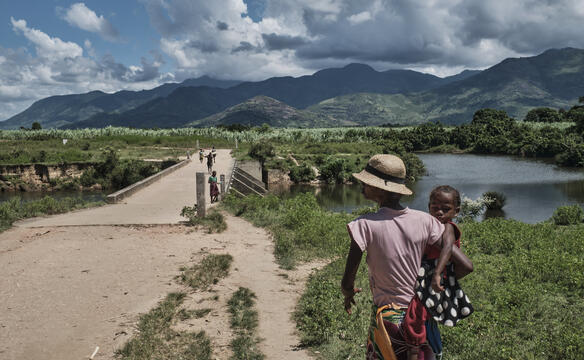
"Our main food is cassava," says Rindra*. "It feeds us in the morning, at lunchtime and in the evening." Cassava is a shrub-like plant that is mainly found in tropical regions. The roots are poisonous in their raw form, but edible when cooked and properly prepared. They taste slightly sweet, similar to a sweet potato. The leaves are also often cooked and eaten. What makes cassava so interesting for Rindra and many other people around the world is that the plant is extremely robust. It cannot tolerate temperatures below 18 degrees, which is why it is virtually non-existent in Germany. On the other hand, it is extremely popular in warm regions as it can withstand dry soil and prolonged drought. Cassava is the main source of food for around one billion people in the world. The plant is more important as a food around the globe than the potato.
Famine despite rich flora
Rindra lives with her husband and three children in the south of Madagascar. The island is known for its lush flora and fauna and the export of vanilla - but there is famine in the south. In parts of the region, it has not rained for years. Even manioc is reaching its limits. Harvests are significantly smaller or even fail altogether. Yet the people here are dependent on what they grow. Rindra and her husband are also dependent on agriculture as self-sufficient farmers.
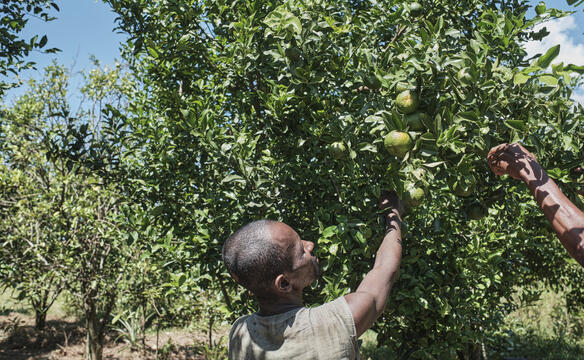
When health workers from humedica's partner organization SEED Madagascar arrive in the village where Rindra and her family live, they also examine her children. They were weak and often ill. "This was mainly due to the unbalanced diet," explains Rindra. To earn money to support her family, she makes mats from palm leaves. However, the money she earns from selling them is not enough - and certainly not enough to buy food for a balanced diet for the children. "Whenever I can, I give the children fruit. I've even planted mandarin trees," she says. But that alone is not enough to strengthen the children's resistance.
"First of all, we have to make sure that the children absorb enough nutrients again and that their bodies become more resilient," reports Natalie. She is the head of a health center in the region that regularly examines and treats malnourished children thanks to humedica's support. "We deliberately involve the whole family in this." The children are given a special peanut diet with lots of nutrients and calories and are monitored on an outpatient basis at regular intervals. Treatment usually lasts around two months.
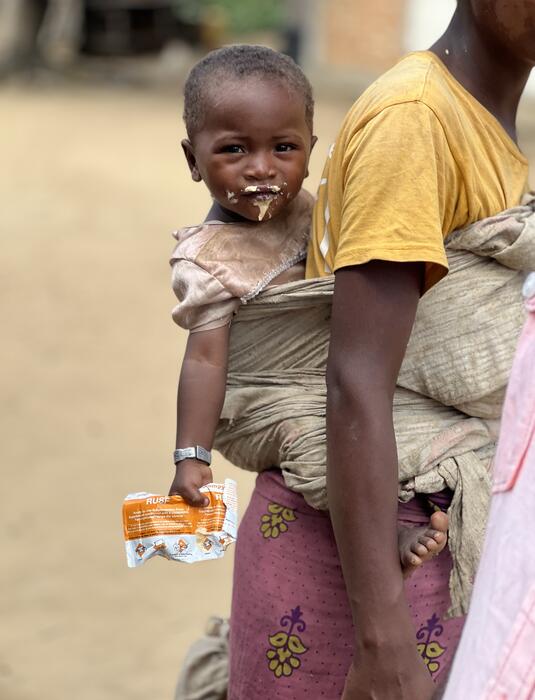
Undernourished children are given a special peanut paste with a particularly high calorie content
And the families also receive food rations during this time. "These nutrient-rich staple foods, such as rice or local vegetables, are intended to supplement the food available to the families. The adults are also hungry. If we didn't give them anything, the families would share the special food for the children and there wouldn't be enough left for the little ones," Natalie knows from experience. However, it is important to her: "The food that we distribute to the families should only ever supplement the families' diet. They must never become dependent on it. The aim is for the families to be able to provide for themselves after our support.
Combating long-term consequences
"The consequences of hunger can be fatal for children," says Natalie. "In the short term, they are weak and more susceptible to illness, like the children of Rindra," she explains, adding: "In the long term, constant hunger leads to significant developmental delays and a reduction in cognitive abilities." As a result, those who suffer from hunger throughout their childhood are often less productive as adults and have difficulty earning a living. A vicious circle that often causes the children of those affected to grow up in poverty.
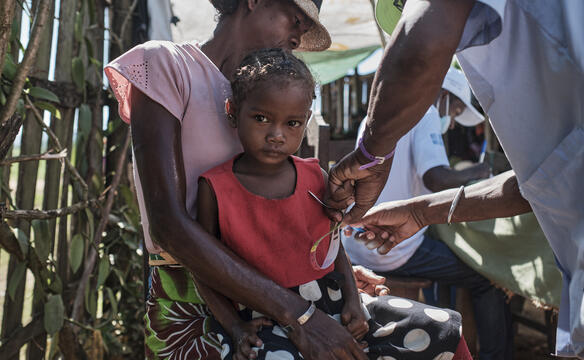
MUAC bands are used to measure the arm circumference of children to find out whether they are malnourished.
Natalie wants to make sure it doesn't have to come to that. Her team regularly visits the villages in the region. "At times when it's particularly dry and the fields don't yield anything, many families try to get by by eating just one meal a day. Of course, that's not enough," explains Natalie. She is aware of another factor that increases malnutrition: "In the dry season, there is often no clean drinking water available. But here in the area, many people see the seawater. The obvious thing for them to do is cook with it. However, this leads to them getting diarrhea. This is fatal for children."
Focus on solutions for families
For Natalie and her colleagues, one thing is clear: drought, poverty and hunger are directly linked. That is why humedica and SEED are working together to improve the situation of people in southern Madagascar in the long term. For them, the focus is not just on the children, but on the whole family. "We advise the families on how they can ensure a balanced, nutritious diet for themselves and their children despite the limited opportunities they have," explains Natalie. "In addition, their self-sufficient agriculture must yield enough again."
Rindra also dreams of this. She would love to grow rice. But she can't afford the equipment. "I would need plows and zebus to pull them," she says. Whenever she can, she experiments with growing new plants. "The tangerine trees will give my children a future," she beams. The three of them are doing better now. One of the children can even go to school. Rindra is doing everything she can to ensure that they have a better future than she did. The support from SEED and humedica has laid an important foundation stone. This is made possible by donations from Germany.
How do you recognize malnutrition in children?
The abbreviation MUAC stands for "Mid-Upper Arm Circumference". These are small measuring tapes used to measure the circumference of a child's upper arm. The MUAC tape has a green, a yellow and a red area. These represent the child's respective nutritional status: Green area (21 to 12.5 cm): adequately nourished. Yellow area (12.5 to 11 cm): moderately malnourished. Red area (under 11 cm): acute malnutrition

By weighing the child and comparing the weight with average values of other children of the same age, the staff can determine whether the child is underweight.
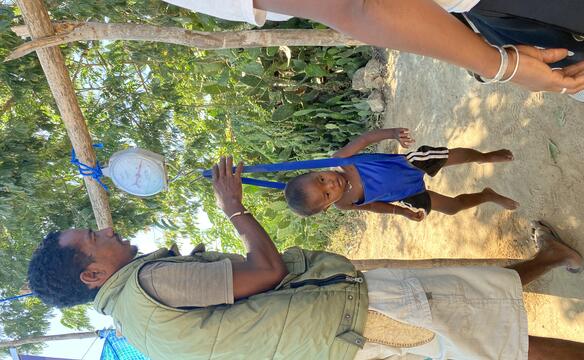
The staff at the health center relate a child's height to his or her age. A low height can indicate long-term malnutrition or repeated illnesses.
This method assesses the child's weight in relation to its height. A low weight in relation to height indicates emaciation, i.e. the child has lost weight rapidly due to insufficient food intake or illness. It is therefore malnourished.