
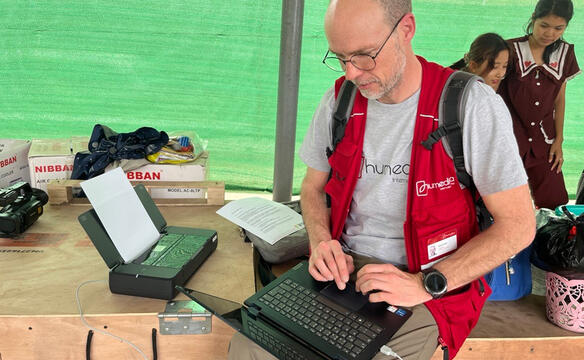
The exploration team tried to assess the situation after the earthquake in Myanmar
"Our mission in Myanmar was a challenge because we didn't know exactly what to expect," says Tobias Kann, who was on site as a logistician after the severe earthquake at the end of March: "The information situation beforehand was so unclear that we initially sent a reconnaissance team to assess the situation on the ground." A ten-strong team of doctors and nurses was able to follow a short time later. With the help of the local population, they set up an outpatient clinic in the courtyard of a hospital affected by the earthquake. The medical team was able to treat almost 1,000 patients there and ensure that they received further treatment from their GPs. They also brought medical supplies and water filters to the affected region.
Emergency services prepare in training sessions
"Intensive preparation is essential in order to be able to provide this aid," explains Kann. This not only means that we have relief supplies such as medicines, treatment tents or the humedica emergency aid kit for initial hygiene care in stock at our headquarters in Kaufbeuren. Preparation also means that our volunteers undergo intensive training. This enables us to put together a trained medical team within a short space of time and help people in need. And we can do this without placing an additional burden on the resources of a shaken country, as the humedica logistician knows: "We work self-sufficiently in the field." In addition, humedica is integrated into the international disaster relief processes. Both are confirmed by the World Health Organization (WHO), which has classified us as an Emergency Medical Team.
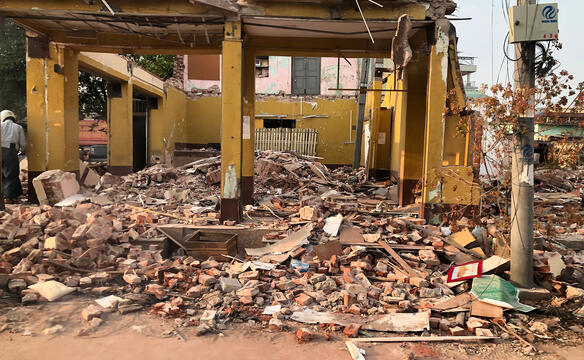
Houses are still uninhabitable after the earthquake in Myanmar at the end of March
After the disaster, our aid continues. In Myanmar too: the infrastructure in the Mandalay region is still badly damaged. "Houses are uninhabitable and hospitals cannot be used," says Kann. What's more, the country in South-East Asia has been in a state of civil war for four years.
Our help continues after the disaster
"Together with our local partner organization, we support those affected in finding their way back into everyday life," says the humedica logistics expert. For example, we are campaigning for the health of mothers and children, offering GP care in a mobile clinic or supporting agriculture with climate-resistant cultivation methods to ensure families' long-term food security.